BLOG

BLOG

RELENTLESS

RELENTLESS

In 2021, Dan Moore collaborated with Angus Andrew of Liars on RELENTLESS, a generative audiovisual work developed from a 3D reconstruction of a cave near Andrew’s home in the Australian bush.

The work begins with an act of traversal. Andrew entered the cave with a 360-degree camera, recording high-definition spherical video from within the space. That footage was later used to reconstruct the cave as a digital environment, translating a physical site into a mutable volumetric image. What might have remained documentation became, instead, a terrain for transformation.

Built inside a 3D game engine, RELENTLESS is not a fixed video in the traditional sense. It is a system that can run indefinitely. The cave becomes a real-time environment, capable of continuously generating image compositions in response to sound. Audio drives the work’s behavior, influencing which frames are selected, how surfaces move, how materials shimmer, and how the composition evolves over time. Some decisions happen live inside the engine. Others are shaped by offline processes and embedded back into the system as latent visual possibilities.

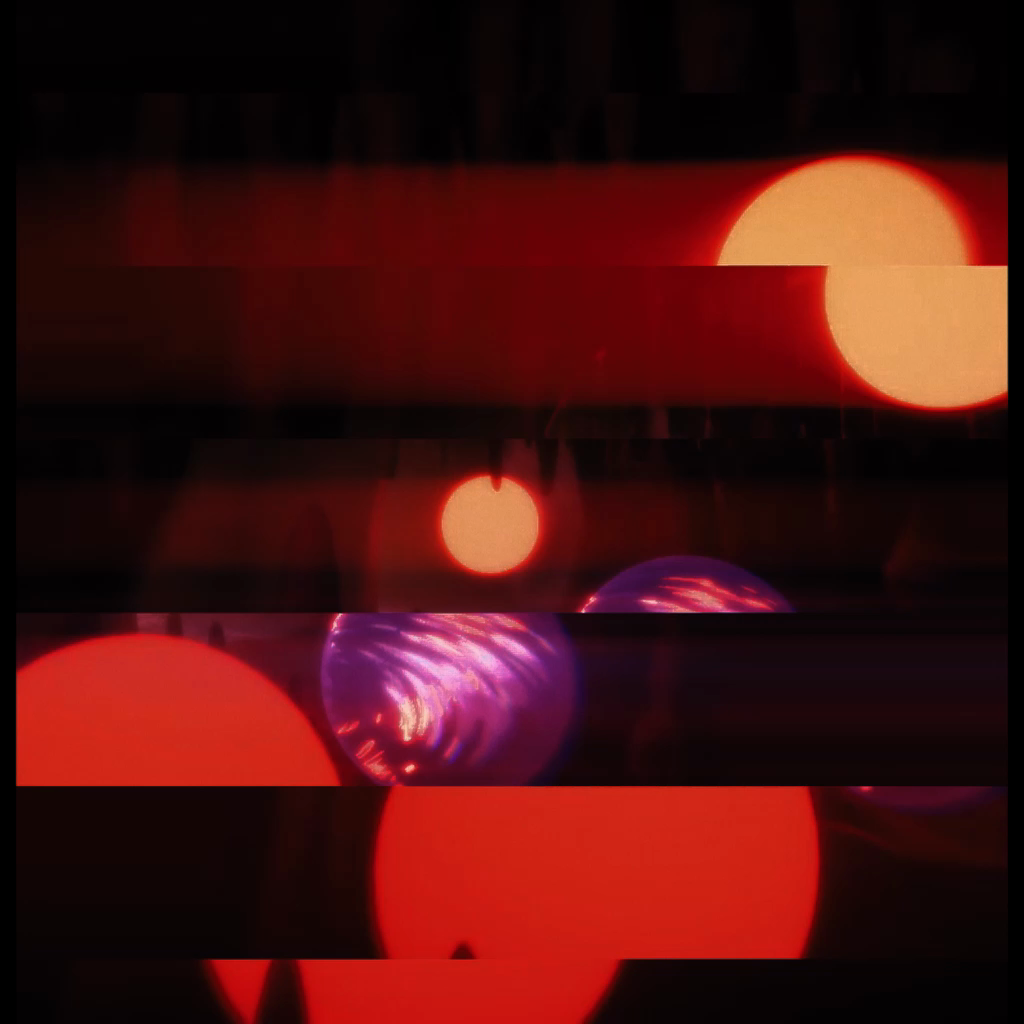
The resulting image moves with an almost oppressive slowness. Glowing red spheres hover in darkness, their heat suggesting both celestial bodies and industrial warning lights. Reflective forms ripple beneath them, liquid and metallic, catching the sound as if it were a physical force. Horizontal bands shear through the frame, interrupting the illusion of depth and exposing the image as a layered signal. The cave is present, but only as a ghost: a source geometry dissolved into light, rhythm, and distortion.

In this sense, RELENTLESS treats reconstruction not as recovery, but as destabilization. The camera captures a site. The software rebuilds it. The engine keeps it alive. The audio unsettles it. What remains is a space caught between memory and machine perception, between landscape and interface. It is neither natural nor synthetic, but something produced through their collision.

The collaboration brings together Andrew’s long-standing interest in repetition, pressure, and psychological atmosphere with Moore’s practice of building systems that negotiate images rather than simply render them. Here, the computer listens. It selects. It interrupts. It turns the cave into an instrument and the song into a force that acts upon matter.

RELENTLESS occupies a space between tour visual, digital sculpture, generative cinema, and real-time simulation. It is slow, molten, and unstable. A private landscape becomes a shared hallucination. A cave in the bush becomes a reflective chamber for sound. The work does not illustrate music. It is shaped by it, frame by frame, endlessly, until place itself begins to pulse.

Dan Moore
Slop Has a Better Name

We call it slop.

That word shows up everywhere now, usually as a dismissal. Slop is the bad output. The extra fingers. The warped face. The sentence that sounds confident but collapses under scrutiny. Slop is treated as a bug, a temporary embarrassment on the way to cleaner systems and better models.

But slop is not accidental. It is what leaks out when the machine cannot hold itself together.

Slop is evidence. A pressure mark left behind when prediction is forced to perform understanding. When probability is asked to stand in for meaning. When systems trained on everything are expected to speak with confidence about anything.

It appears as extra limbs, broken objects, melted faces, confident language that says nothing. These are not charming glitches. They are fractures. Billions of images and texts crushed into vectors and averages. Context erased. Labor dissolved. Authorship smeared thin. What comes back is not memory, but residue.

Slop was always too casual a word for this condition.

It makes the problem sound light, disposable, almost humorous. But what I am actually working with feels heavier. Slower. Cooked rather than broken. For that, I use a different word.

Bouillie.

Bouillie means mash. Porridge. A soft mass without structure. Something that was once distinct, now stirred together until its edges disappear. It implies heat, pressure, repetition. Not a sudden failure, but a gradual collapse. Form losing its ability to hold itself.

This is what happens when generative systems are pushed past coherence.

Prediction is heated until it softens. Probability is asked to behave like understanding. Culture is overcooked. Billions of images and texts are compressed, averaged, and blended until meaning loses its stiffness. Context dissolves. Labor disappears. Authorship turns viscous. What comes out is not memory. It is mixture.

I am drawn to this condition because it tells the truth by accident.

When a model hallucinates, it exposes the scaffolding underneath representation. You can see how meaning has been flattened, how correlation has replaced understanding. The output is not imagination. It is a dataset trying to remember itself and failing, reheated until structure gives way.

What unsettles me most is how familiar bouillie feels.

A face that almost holds together. A hand that knows the gesture but not the anatomy. Bouillie does not fail loudly. It fails quietly. It invites you to finish it, to project coherence onto something that cannot sustain it on its own. You hesitate. You look longer than you should. You participate.

That invitation is where power lives.

Bouillie borrows credibility from recognition. This extends far beyond images. The same softness appears in generated language, automated judgments, synthetic explanations. Everything looks complete. Nothing is firm. Bouillie is certainty without grounding.

I work by slowing this down.

I repeat the mixture. I let it thicken. I translate it into physical labor, into oil paint, into robotic motion that does not know when to stop. A machine repainting the same broken form does not correct it. It stirs it again. Duration replaces intention. Weight replaces clarity.

There is no clean authorship here.

My hand is present. The machine’s hand is present. The dataset is present like sediment. Responsibility is spread thin, impossible to isolate. Bouillie makes this visible. No stable origin. No singular intention. Just accumulation.

What concerns me most is how quickly this condition becomes normal.

The mixture cools. The texture stabilizes. Yesterday’s breakdown becomes today’s style. Systems train on their own outputs. The slurry feeds itself. What once felt unstable becomes expected.

I do not work with bouillie to fix it.

I work with it because pretending it can be reformed into solid structure is dishonest. Because smoothing it over only hides how little is actually holding things together.

Slop was the symptom.

Bouillie is the state.

It is culture after structure.
Meaning after collapse.
A system still producing, long after coherence has thinned into paste.

ARTDan MooreArt, Ai, Slop, GenAIComment